

The Australia & New Zealand Prevocational Medical Education Forum (ANZPMEF), hosted in Sydney and supported by NSW Health and HETI, was a powerful reminder of why this community matters. The forum continues to be one of the few places where educators, trainees, executives, and innovators come together to reflect on what’s working, what’s not, and what’s emerging across the medical education landscape.
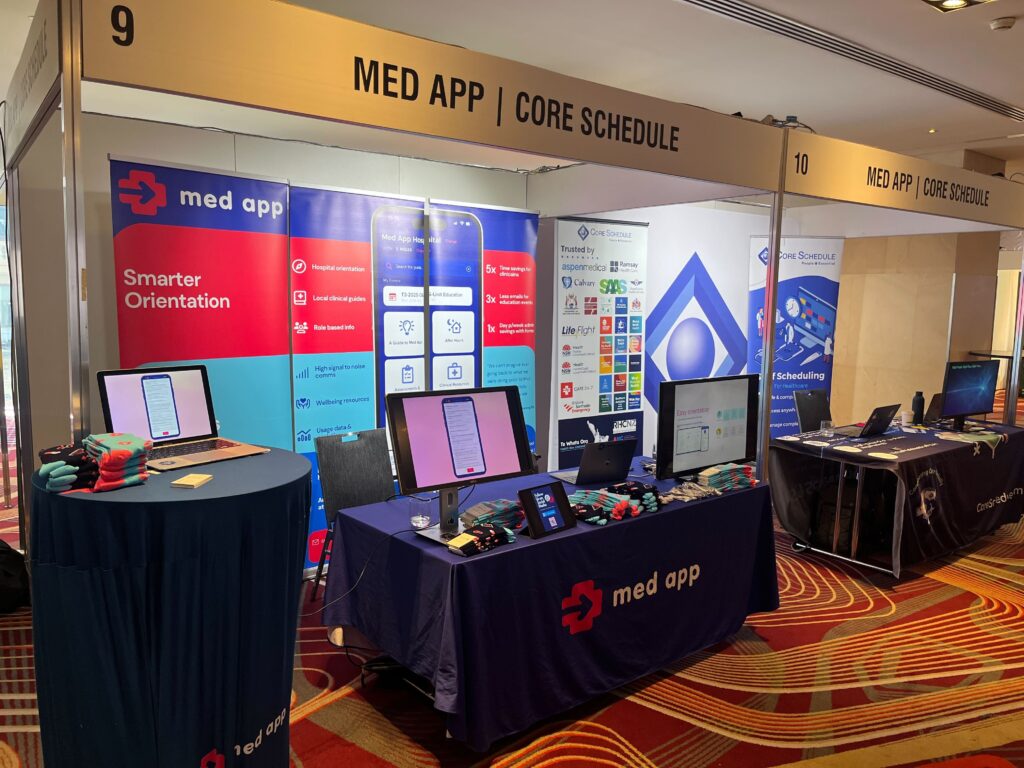
As always it was great to share a booth with our colleague from Core Schedule – our alliance puts us closer and closer to removing all friction points that exist between a facility and a clinician – saving countless hours of unnecessary administration and ultimately benefiting patient care and wellbeing.
Reconnecting with our community
One of the highlights—as always—was reconnecting with our current customers and partners, hearing about their local wins, challenges, seeing their posters, and presentations. There’s something energising about seeing the work that’s been quietly happening all year suddenly lifted onto the national stage.
Across conversations, a clear sense of anticipation emerged: the year’s end approaching, a new cohort of Interns on the horizon, and the shared urgency to keep improving the systems that support them.
It was also fantastic to spend time with colleagues from across the country—from Western Australia to regional NSW and Victoria—and with our friends across the ditch in New Zealand. These are teams we don’t get to see as often, and their perspectives consistently broaden the conversation in meaningful ways.
What we heard
Sifting through presentations, posters, and informal discussions, several themes repeatedly surfaced:
- Orientation and onboarding remain a major operational and cultural challenge.
- Engagement and wellbeing continue to be top of mind for educators and administrators.
- Feedback quality and consistency is recognised as vital, yet still variable.
- Administrative load reduction—particularly around access to supports and learning resources—is seen as essential to improving the intern and trainee experience.
- AI is here, what will it mean?– Huge focus on AI in clinical workflows and decision making, but opportunity exists on the HR, Admin and education side of things.
It’s always valuable to test whether the work we do at Med App continues to be relevant. Based on what we saw and heard, the answer is yes: the need for streamlined communication, structured orientation, and removing paper and manual workflows from a clinicians working lives.
Some Frustrations
One notable gap in the discourse was the absence of commentary on integrations relating to Clinical Learning Australia (CLA).
While there was plenty of fanfare around implementation milestones (and rightly so), several substantive issues were left untouched:
- The financial and economic cost of rollout delays
- The confusion caused by variable use of CLA across the country
- The lack of clarity on data-sharing pathways
- The growing reliance on external consultants, despite broader system concerns
Given the scale of investment and the national impact, it was surprising that these questions weren’t explored. Integration, interoperability, and practical workflows matter—especially for the clinicians and educators using these systems daily.
Unexpected Conversations (and Lessons Learned)
Unexpected Conversations (and Lessons Learned)
One of the more interesting—and admittedly frustrating—conversations came from a former customer whose executive team had previously made the decision to stop using Med App a couple years ago. During the conference, multiple individuals from those same sites approached us asking:
- “How do we turn Med App back on?”
- “It is so much easier than what we have to do now.”
- “We’ve noticed the Nurses are still using Med App—can we reactivate it?”
We’re now beginning a process of re-engaging with each site individually, which will inevitably mean more time, cost and administrative effort for everyone.
The lesson here:
Our team must engage more effectively with executives—not just local champions.
The value must be clearly communicated at every level. In health, there are many people who can say no, far fewer who can say yes, and only a small handful with the courage to actually say yes. Getting the right information to these people is seemingly just as important as delivering what you say you will.
Access, clarity, alignment, and courageous decision-making matter.
To everyone who stopped by the booth—thank you. We genuinely appreciate your time, your curiosity, and your honesty. Conferences like ANZPMEF remind us why this work matters and why collaboration across systems, states, and professions is essential.
We look forward to supporting more of you in 2026.



0 Comments